Kenneth Rogoff is Professor of Economics and Public Policy at Harvard University, and was formerly chief economist at the IMF. He wrote an article for Project Syndicate titled Russia’s Skeptical G8 Partners. Here’s a example of the professor’s economic professionalism:
Why wasn’t Chinese president Hu Jintao, whose country’s economy is the world’s second largest (when measured at world prices), given a seat at the table instead of Putin? After all, even with all its energy resources, and even with today’s sky-high oil and gas prices, Russia’s national income is only about the size of Greater Los Angeles
Prof. Rogoff takes China’s GDP measured in purchasing power parity dollars and compares it to Russia. Well, prices on goods and services in China are definitely many times lower then in Russia or in America (one only needs to visit Walmart). Then he takes Russia’s GDP measured in official exchange rate dollars and compares it to Greater Los Angeles. But even here Prof. Rogoff is twisting facts. Official exchange rate GDP of Russia is $740 billion but GDP of Greater LA is $500 billion. Are 740 and 500 "comparable"?! I envy Prof. Rogoff's students - it must be a cakewalk writing term papers in his class.
http://www.lawa.org/news/newsDisplay.cfm?newsID=91
Citing data provided by the Southern California Association of Governments (SCAG), the study projects a Greater Los Angeles area population of more than 21 million people, a work force of 9.9 million men and women, and a gross domestic product of more than $600 billion by the year 2015. Today’s figures are 15 million people, 6.87 million employed, and $500 billion GDP.
IMHO even by 2015 Greater LA's GDP will be uncomparable with current GDP of Russia.
Now I have a great counter-argument for Prof. Rogoff. After all, even being the greatest power in the world the US GDP per capita is at the level of US$ 41 800 while a god forgotten, permafrost bound region of Ymalo-Nenetsk in Siberia boasts US$ 52 000 GDP per capita.
For your information – some facts from CIA Factbook:
China
GDP (purchasing power parity):
$8.859 trillion (2005 est.)
GDP (official exchange rate):
$2.225 trillion (2005 est.)
GDP - real growth rate:
9.9% (official data) (2005 est.)
GDP - per capita (PPP):
$6,800 (2005 est.)
Russia
GDP (purchasing power parity):
$1.589 trillion (2005 est.)
GDP (official exchange rate):
$740.7 billion (2005 est.)
GDP - real growth rate:
6.4% (2005 est.)
GDP - per capita (PPP):
$11,100 (2005 est.)
Tuesday, June 27, 2006


Monday, June 26, 2006
Oil Addiction
A week ago USA Today published an editorial titled “Oil Addiction”. The author laments that oil addiction makes US government too soft of dictatorial and tyrannical regimes. Of course, Russia is included as an example of an oil rich dictatorship. In truly Puritanical tradition the author appeals to the superiority of moral values over materialistic needs such as consuming energy. I doubt that if America refuses to buy oil from dictators, such as Saudi Arabia, Venezuela, Iran, etc. its citizens rejoice and stop driving SUVs, using air-conditioning and start paying triple utility bills. The author writes:
Much of the problem is driven by the USA, which accounts for a quarter of the world's oil consumption. There are no easy solutions. Increased gas taxes are a tough sell. Domestic drilling is inadequate to the task. And practical alternatives to oil might or might not materialize. But as unappealing as these may be, ignoring troubling world developments is worse.
One place to start is to recognize that the central question is not what we should pay for energy but how we should pay for it. If we can begin to shift the hidden costs away from the taxpayers and onto energy consumers, the true nature of our addiction will be more visible.
Somehow US Today editors and many other dictatorships’ watchers forget about the other side of the problem with high oil prices. Very high oil prices – or better said constantly increasing oil prices – are beneficial for contemporary American economic policies. Oil trade in the world is done in American dollars – green pieces of paper printed in the US. Since March 2006 the world doesn’t even know how much green paper America currently prints. But as long as increased amount of green paper is happily consumed by international oil traders due to increasing oil prices, everything is ok. America can afford its tremendous budget deficit not fearing inflation.
There’s a traditional scary story for Russia – your economy will collapse when oil prices go down. Probably it’s true. But low oil prices will also make a lot of American green paper useless – it will flood back to its native land. Is America ready to live with huge budget proficit? Is it ready to live with double digit inflation? Ironically the financial crisis could also solve the problem of oil addiction – unemployed don’t drive SUVs even if gas is very cheap.
Much of the problem is driven by the USA, which accounts for a quarter of the world's oil consumption. There are no easy solutions. Increased gas taxes are a tough sell. Domestic drilling is inadequate to the task. And practical alternatives to oil might or might not materialize. But as unappealing as these may be, ignoring troubling world developments is worse.
One place to start is to recognize that the central question is not what we should pay for energy but how we should pay for it. If we can begin to shift the hidden costs away from the taxpayers and onto energy consumers, the true nature of our addiction will be more visible.
Somehow US Today editors and many other dictatorships’ watchers forget about the other side of the problem with high oil prices. Very high oil prices – or better said constantly increasing oil prices – are beneficial for contemporary American economic policies. Oil trade in the world is done in American dollars – green pieces of paper printed in the US. Since March 2006 the world doesn’t even know how much green paper America currently prints. But as long as increased amount of green paper is happily consumed by international oil traders due to increasing oil prices, everything is ok. America can afford its tremendous budget deficit not fearing inflation.
There’s a traditional scary story for Russia – your economy will collapse when oil prices go down. Probably it’s true. But low oil prices will also make a lot of American green paper useless – it will flood back to its native land. Is America ready to live with huge budget proficit? Is it ready to live with double digit inflation? Ironically the financial crisis could also solve the problem of oil addiction – unemployed don’t drive SUVs even if gas is very cheap.
Wednesday, June 21, 2006
Circles of Hate
Kirill Pankratov wrote a review of Gary Shteyngart’s book “Absurdistan” in eXile. Here are some of his thoughts about peculiarities of American hate that I fully support:
There is a strict differentiation in the American media and cultural space con-cerningz whom you can hate or despise and how. One must be very careful with anybody non-white, of course. Blacks are strictly off-limits. Asians are too, for the most part. You can't say anything truly bad about Jews (you can criticize Israel's policies as much as you'd like to, but you risk being labeled an anti-Semite). You can make fun of Germans, but they are so neutered and inoffensive these days it's like making fun of pigeons. It is pretty safe to hate and mock French. But then again, how much can you milk tired jokes about "surrender monkeys" and rude garcons in Parisian restaurants?
But it is totally permissible to hate and despise Russians. It is as if a huge sign is flashing over the media landscape: "Here you may shit as much as you want!" There is a very small number of roles that Russians can play in American popular art vicious mafia thugs and their molls, obnoxious fat apparatchiks, half-starving babushkas, raving alcoholics, pitiful girls exploited for sex trade, or the occasional brave pro-Western dissident or a spy. Any kind of "normalcy" is simply forbidden. There are a few objective reasons for that:
1) During many decades of the Cold War the West conditioned its own plebs to hate and dehumanize the "savage Russian enemy," so this line produces automatic brand-recognition and little mental resistance; there is no "Russian lobby" in the US, but many ethnic anti-Russian lobbies (e.g. Ukrainian, East-European, Jewish, Baltic) were nurtured for decades;
2) Russians are essentially white Europeans (even if alluded to as "Asiatic despotism" on a proper occasion), so hating and despising them is safe from the dreaded "racism" label;
3) Russians are not known for mobs rampaging through streets because of some prophet caricatures published in an obscure newspaper, nor they likely to issue fatwas to kill offending authors, or actually cut their throats; so it is safe in a cowardly way.
It was a real shock to meet several people who were extremely tactful and delicate when talking about evident cases of black racism but at the same time feel absolutely free to make spiteful and malicious generalizations about Russian ‘chicks’ or Russian “rudeness”. And they knew that I am Russian and that I am insulted by such remarks. Nobody knows how much hate brawls in souls of always friendly smiling PC talking people. В тихом омуте черти водятся.
There is a strict differentiation in the American media and cultural space con-cerningz whom you can hate or despise and how. One must be very careful with anybody non-white, of course. Blacks are strictly off-limits. Asians are too, for the most part. You can't say anything truly bad about Jews (you can criticize Israel's policies as much as you'd like to, but you risk being labeled an anti-Semite). You can make fun of Germans, but they are so neutered and inoffensive these days it's like making fun of pigeons. It is pretty safe to hate and mock French. But then again, how much can you milk tired jokes about "surrender monkeys" and rude garcons in Parisian restaurants?
But it is totally permissible to hate and despise Russians. It is as if a huge sign is flashing over the media landscape: "Here you may shit as much as you want!" There is a very small number of roles that Russians can play in American popular art vicious mafia thugs and their molls, obnoxious fat apparatchiks, half-starving babushkas, raving alcoholics, pitiful girls exploited for sex trade, or the occasional brave pro-Western dissident or a spy. Any kind of "normalcy" is simply forbidden. There are a few objective reasons for that:
1) During many decades of the Cold War the West conditioned its own plebs to hate and dehumanize the "savage Russian enemy," so this line produces automatic brand-recognition and little mental resistance; there is no "Russian lobby" in the US, but many ethnic anti-Russian lobbies (e.g. Ukrainian, East-European, Jewish, Baltic) were nurtured for decades;
2) Russians are essentially white Europeans (even if alluded to as "Asiatic despotism" on a proper occasion), so hating and despising them is safe from the dreaded "racism" label;
3) Russians are not known for mobs rampaging through streets because of some prophet caricatures published in an obscure newspaper, nor they likely to issue fatwas to kill offending authors, or actually cut their throats; so it is safe in a cowardly way.
It was a real shock to meet several people who were extremely tactful and delicate when talking about evident cases of black racism but at the same time feel absolutely free to make spiteful and malicious generalizations about Russian ‘chicks’ or Russian “rudeness”. And they knew that I am Russian and that I am insulted by such remarks. Nobody knows how much hate brawls in souls of always friendly smiling PC talking people. В тихом омуте черти водятся.
Wednesday, May 31, 2006
Curious statistics
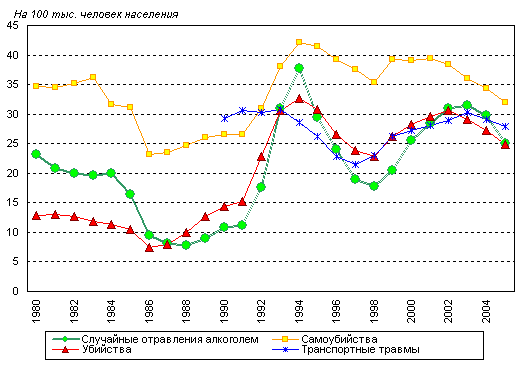
Causes of death per 100 thousand of population from 1980 till 2005.
Green – accidental alcohol poisoning
Red – homicides
Yellow – suicides
Blue – road accidents
Tuesday, May 30, 2006
The essence of Russia
This is a real gem. I don't know how much time it took Robert to write this wonderful column but he caught the the very essence of Russia. Copied and pasted from Moscow News "Is Chaos Key to Russian Soul?" by Robert Bridge:
It was during a walk through my American hometown with a friend from Moscow when I first felt the wide chasm separating the Russian and Western mentalities. During our suburban stroll, we came upon an old vacant house that had been up for sale for months. The owner had died and apparently there was nobody in the family to take care of the property. The lawn looked more like a wheat field, with crazy weeds and wild flowers sprouting up in strange places.
I was just about to explain why the property was such a mess when my Russian friend exclaimed, "You know, this is my favorite yard in the neighborhood."
I started to laugh until I realized that my friend was absolutely serious.
How strange, I thought. While the other houses boasted finely manicured lawns, with grass so perfect you could practice your golf putt, this uncultivated jungle - complete with mouse holes and a beehive - got the best reviews.
About a month later, the house was sold. No sooner had the moving vans departed then the landscapers pulled up to the curb. The lawn was de-weeded, sprayed with chemicals, and given a military-style crew cut. The diehard dandelions - the archenemy of every American gardener - had all been vaporized. The hedges were trimmed into perfect squares and rich black mulch was spread underneath them to give an accurate border at the grass line. To the dismay of my Russian friend, the verdant vegetation had been transformed into an immaculate American yard, complete with the Stars and Stripes fluttering from the freshly painted porch.
I will always remember my Russian friend's opinion of that overgrown lawn, which became for me a metaphor for Russia itself: On the surface, it may seem cluttered, disorganized, haphazard, and perhaps even a little bit dangerous. After all, even weeds are considered flowers in Russia, and in the summertime children wear tediously woven diadems of dandelions.
"Even if I do not believe in the divine order of things" exclaimed a Dostoevsky character, "the sticky young leaves emerging from their buds in the spring are dear to my heart; so is the blue sky and so are some human beings..."
My first impression of Russia was one of unbridled spontaneity, a soft anarchy of sorts, where rules and regulations seem to take a backseat (without a seatbelt) to the human spirit. This will come as a bit of a shock - if not a breath of fresh air - to many westerners.
The culture shock is immediately apparent on the wild drive from Sheremetyevo airport. The drivers all seem to have studied from different driving manuals and the only reason for the presence of the road police, as far as I could tell, is to pull over the foreign sports cars.
But even on Russian roads, there is an underlying order to the chaos that the western mentality can barely perceive. The drivers in Russia, for example, cut each other off with a brazen disregard that would explode into road rage on American highways. Russian drivers heed the maxim, "nature abhors a vacuum." In other words, if there is an opening, the Russian driver will fill it, be that on a sidewalk or wherever. Yet, fastening your seatbelt is considered an insult to the driver.
And then there are the notorious Russian queues, a phenomenon that deserves serious anthropological study.
In America, when you go to the doctor's office, for example, you take a number and have a seat in the waiting room. When your number is called, the doctor will see you. Pretty straightforward. In Russia, you walk into a riot, ask who is last, and tell that person to hold your spot and then go shopping or something. You return about an hour later and hop back into line like nothing happened. This drives Westerners nuts. Then (then!), while all this is happening, or not happening, people are attacking the gates from other directions, with all kind of plausible and not so plausible explanations.
Yet, in the midst of this chaos, it seems the Russians truly enjoy the lively debate, the human friction, the feeling of being on the edge of god knows what.
Across the Russian capital, the sound of lawnmowers and the smell of cut grass are becoming more common. Grass is sprouting up everywhere. A woman I know even replaced her lush garden at the dacha with grass seed.
Yes, the weed whacker of Western rationalization is slowly making headway against Russian impulsiveness; I just hope it does not supplant what makes Russia so unique.Thursday, May 25, 2006
More on Cold War 2
I already wrote how Dick “Sharpshooter” Cheney gave Russia a very powerful signal – what it should really do to become democratic. Mark Ames has an excellent article (one of his best, I think) on the very same topic “How Dick Cheney Got His Cold War On: A Cold War Timetable” published in eXile.
Cheney's speech raised a lot of questions and a lot of debate, but no one asked one of the most obvious questions of all: Why did Cheney choose to flaunt his hypocrisy in everyone's faces? Why not try faking it, the way most Western leaders operate when they mix righteous words with rapacious policies? Why didn't Cheney choose to put a bit of space in between his speech attacking Russia's record on democracy and his visits to the despotic Central Asian states?
Or put another way, what if it wasn't a mistake. What if the blatant, insane hypocrisy WAS the real message...and always has been all along?
So it was a huge risk for Putin to cozy up so closely to America post-9/11. He went out on a limb, made a bold move against his own powerful base, in the hope that the benefits of a mutually-supportive relationship with America would in the end prove him right and make him, and Russia, stronger.And at first it looked like he might be right, as America was undergoing Pootimania.
But then America won the war in Afghanistan much more easily and quickly than we or anyone else thought. And that war victory went to our heads. Suddenly, we decided we didn't need Putin's help anymore. In fact, as the Newsweeks triumphantly declared, we didn't need anyone's help anymore. America was not just a superpower, it was a hyperpower, perhaps the most powerful (and benign) empire that the world had ever seen.
On December 13th, 2001 after it was clear that Afghanistan had fallen to our allies Bush announced that America was unilaterally withdrawing from the ABM Treaty.
Putin went on national television, clearly stunned and weakened, calling Bush's move a "mistake." It was a painful broadcast, egg dripping from his face. I've never seen Putin so clearly bitch-slapped before or since.
I remember being shocked at what assholes we'd turned out to be. I couldn't understand why Bush didn't wait even, say, two or three months, at least for the victory dancing to settle down in Afghanistan, maybe throw Russia a bone or two. What was behind the timing?
I contacted a good friend of mine in the Defense Department to ask him why we chose to withdraw from the ABM treaty in such a time and manner as to maximally embarrass Putin for having sided with us. Why didn't we wait?
My DoD friend seemed surprised. "We didn't even consider the effect on Putin," he answered. "We only considered what's in our own interest, which is to withdraw now. Besides, we got rid of the Taliban, that was a favor enough for the Russians in our opinion." At the time, Russian anger over Bush's decision to start building a missile shield was dismissed as old Russian paranoia, a holdover of Cold War thinking. Russia had "nothing to worry about," we said.
Democracy isn't about voting. It's about serving America's interests. And serving America's interests is more tightly defined a serving the interests of the oil oligarchs in Houston, where Cheney spent the previous ten years. In fact, it's even more simple than that it's personal. America's interests are Cheney's interests. Il est l'etat. In that sense, Putin is indeed a genuine menace. And that's what makes this Cold War so different. Whereas the last one was a mortal struggle over two different systems, this is a struggle between two short, balding, bloodless men, and the oil other people's oil that made them as powerful as they are today.
Read more…
Cheney's speech raised a lot of questions and a lot of debate, but no one asked one of the most obvious questions of all: Why did Cheney choose to flaunt his hypocrisy in everyone's faces? Why not try faking it, the way most Western leaders operate when they mix righteous words with rapacious policies? Why didn't Cheney choose to put a bit of space in between his speech attacking Russia's record on democracy and his visits to the despotic Central Asian states?
Or put another way, what if it wasn't a mistake. What if the blatant, insane hypocrisy WAS the real message...and always has been all along?
So it was a huge risk for Putin to cozy up so closely to America post-9/11. He went out on a limb, made a bold move against his own powerful base, in the hope that the benefits of a mutually-supportive relationship with America would in the end prove him right and make him, and Russia, stronger.And at first it looked like he might be right, as America was undergoing Pootimania.
But then America won the war in Afghanistan much more easily and quickly than we or anyone else thought. And that war victory went to our heads. Suddenly, we decided we didn't need Putin's help anymore. In fact, as the Newsweeks triumphantly declared, we didn't need anyone's help anymore. America was not just a superpower, it was a hyperpower, perhaps the most powerful (and benign) empire that the world had ever seen.
On December 13th, 2001 after it was clear that Afghanistan had fallen to our allies Bush announced that America was unilaterally withdrawing from the ABM Treaty.
Putin went on national television, clearly stunned and weakened, calling Bush's move a "mistake." It was a painful broadcast, egg dripping from his face. I've never seen Putin so clearly bitch-slapped before or since.
I remember being shocked at what assholes we'd turned out to be. I couldn't understand why Bush didn't wait even, say, two or three months, at least for the victory dancing to settle down in Afghanistan, maybe throw Russia a bone or two. What was behind the timing?
I contacted a good friend of mine in the Defense Department to ask him why we chose to withdraw from the ABM treaty in such a time and manner as to maximally embarrass Putin for having sided with us. Why didn't we wait?
My DoD friend seemed surprised. "We didn't even consider the effect on Putin," he answered. "We only considered what's in our own interest, which is to withdraw now. Besides, we got rid of the Taliban, that was a favor enough for the Russians in our opinion." At the time, Russian anger over Bush's decision to start building a missile shield was dismissed as old Russian paranoia, a holdover of Cold War thinking. Russia had "nothing to worry about," we said.
Democracy isn't about voting. It's about serving America's interests. And serving America's interests is more tightly defined a serving the interests of the oil oligarchs in Houston, where Cheney spent the previous ten years. In fact, it's even more simple than that it's personal. America's interests are Cheney's interests. Il est l'etat. In that sense, Putin is indeed a genuine menace. And that's what makes this Cold War so different. Whereas the last one was a mortal struggle over two different systems, this is a struggle between two short, balding, bloodless men, and the oil other people's oil that made them as powerful as they are today.
Read more…
Tuesday, May 23, 2006
Desiphering Putin
Another mysterious Putin’s joke nobody could decipher. A year ago when talking about Polish president Kwasnevki – who said, “
Subscribe to:
Posts (Atom)

